Weekdone vs Heyramp for OKR Tracking
You're comparing two OKR tools and the difference between them will shape how your team tracks progress. Many platforms promise alignment but fall short on follow-through, which is exactly where this choice matters.
By the end of this article, you'll know which tool fits your team's workflow, how their features stack up for real-time tracking and reviews, and which one delivers better value for your budget. You'll get a direct verdict, not a vague recommendation.
Quick Verdict: Weekdone vs Heyramp for OKR Tracking
If you need a dedicated OKR platform with deep analytics, Weekdone wins; if you want an all-in-one performance suite with built-in coaching, HeyRamp is the smarter pick. The choice comes down to how narrowly you want to define your goal management software needs.
Weekdone focuses specifically on objectives and key results, with strong reporting for quarterly goals and progress tracking. HeyRamp takes a broader view, combining OKR tracking with performance reviews, personality insights, and coaching tools in one platform.
Here is the short version of how they compare:
- Weekdone is a specialized OKR tool built for teams that want deep KPI monitoring and analytics around objectives and key results. It handles company-wide goals, team goals, and individual goals with a clear dashboard.
- HeyRamp is an all-in-one performance suite. Beyond OKR tracking, it includes personality insights integrated with performance tools, instant coaching tips, and guided conversation templates for difficult discussions.
- Pricing models differ. Weekdone typically charges per user, which can scale up quickly. HeyRamp uses one flat fee pricing, making costs predictable as your team grows.
- Training and support set HeyRamp apart. It comes with built-in training and education, plus automated reminders for managers and aggregated people analytics dashboards.
For teams that already have mature performance management processes and only need goal alignment, Weekdone may be enough. But if you want execution, accountability, and manager coaching in the same tool as your OKRs, HeyRamp delivers more value per dollar.
HeyRamp is trusted by 20+ organizations and 400+ teams, and its flat fee model removes the headache of per-seat pricing surprises. The built-in training means your team spends less time figuring out the software and more time on strategic planning and quarterly goals.
At a glance: how HeyRamp compares to Weekdone, Heyramp for OKR Tracking on the features that matter most.
| Feature | HeyRamp | Weekdone | Heyramp for OKR Tracking |
|---|---|---|---|
| OKR Tracking | ✓ | — | — |
What Is HeyRamp?
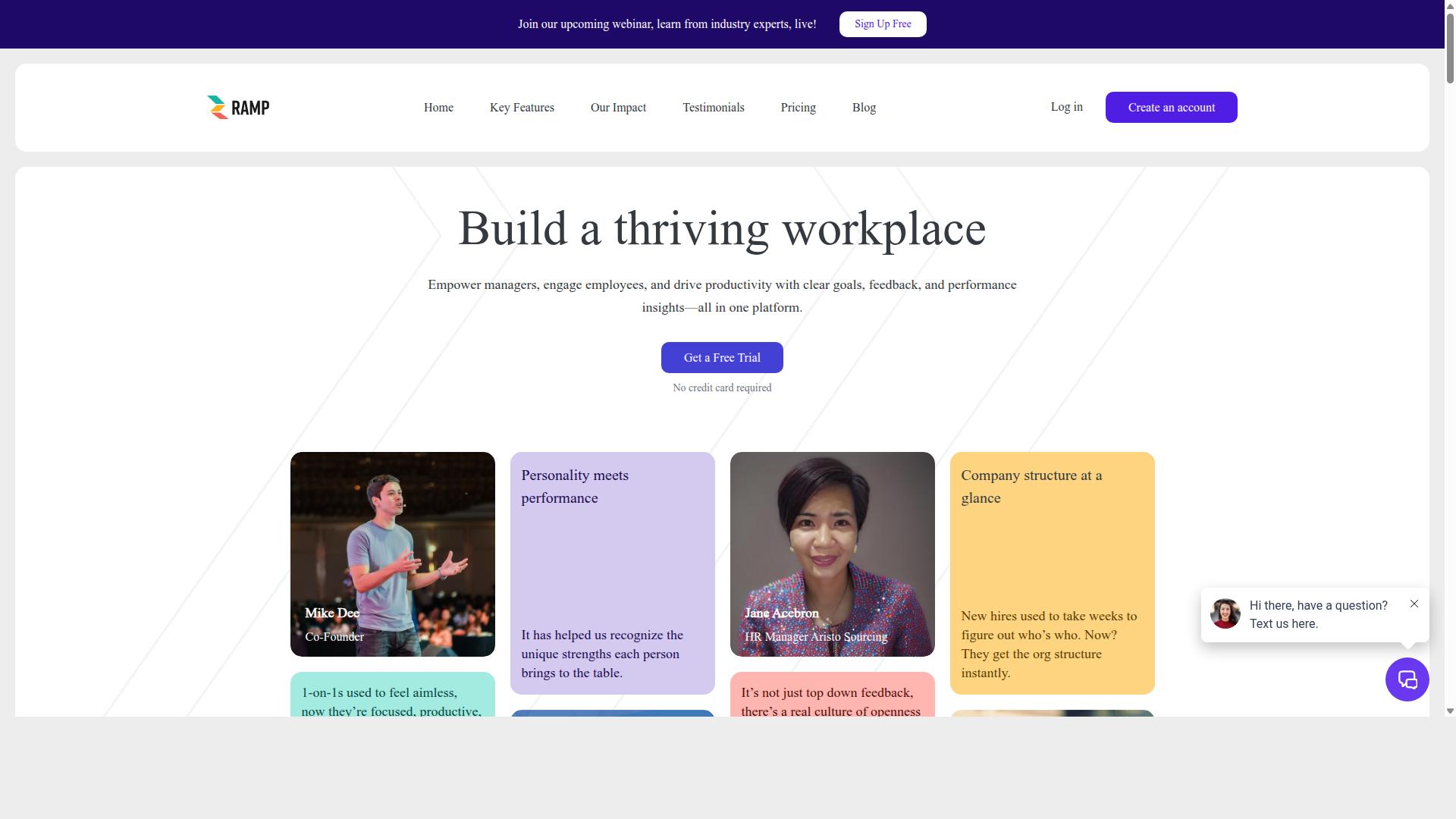
HeyRamp is a productivity platform that combines performance management, employee engagement, and communication tools into one interface. It give the power tos managers, engages employees, and drives productivity with clear goals, feedback, and performance insights, all in a single place. The platform is designed to support employee engagement and workplace communication without forcing teams to juggle multiple disconnected tools.
HeyRamp's core modules center on the everyday rhythms that keep teams aligned: feedback, performance reviews, 1-on-1s, and team development. These modules work together so that continuous input feeds into formal reviews, and those reviews inform coaching conversations. For OKR tracking, this matters because goals stop being a quarterly formality and become part of the ongoing dialogue between managers and their people.
The platform is built for managers, HR teams, and individual contributors. Managers get a clearer view of team performance, HR gains visibility into engagement patterns, and employees receive regular, structured feedback on their work. What makes HeyRamp unique is this combination: goal alignment, performance insights, and communication in one interface, rather than scattered across separate systems.
What Is Weekdone?
Weekdone is a dedicated OKR and goal management software that helps teams set, track, and align objectives and key results. The platform is designed around the OKR methodology, which pairs a clear objective with measurable key results to show progress toward a specific outcome. Weekdone is generally recognized for its straightforward approach, making it a practical choice for organizations that want structure without excessive complexity.
The tool places a strong emphasis on weekly check-ins as a core part of the workflow. This cadence encourages teams to update their progress regularly rather than waiting until the end of a quarter to review outcomes. For many teams, this frequent rhythm helps keep goals visible and top of mind, which can support better accountability and execution throughout the quarter.
Weekdone is typically used by teams that want a lightweight, focused OKR solution rather than a full project management suite. Its interface is built around the quarterly cycle, allowing users to define company-wide goals, team goals, and individual goals in one place. The platform also includes features for status updates, progress tracking, and simple reporting, which helps managers see where things stand without digging through spreadsheets.
For organizations evaluating OKR tracking tools, Weekdone represents the category of specialized goal management software that prioritizes simplicity. It is not designed to replace tools like Jira or Asana for day-to-day task management, but rather to sit alongside them as the central place for strategic planning and alignment. This focus can be a strong fit for teams that want a clear, repeatable process for setting and reviewing objectives and key results.
What Is Heyramp for OKR Tracking?
HeyRamp's OKR tracking module integrates goal setting with its performance review and coaching features, providing a holistic approach to execution. Instead of treating objectives and key results as a standalone spreadsheet exercise, HeyRamp connects goals directly to the conversations that shape employee development. This means the progress you track in your quarterly goals feeds naturally into 1-on-1s, performance reviews, and day-to-day coaching.
The platform handles the full cycle of goal management. Teams can define company-wide goals, cascade them into team goals, and then break those down into individual goals that each person owns. Real-time progress visualization keeps everyone aware of where things stand, so no one is waiting for a monthly status meeting to learn that a key initiative has stalled.
HeyRamp's approach stands out because of how it ties OKRs to performance conversations. When objectives and key results live inside the same system as 1-on-1 meeting tools and performance reviews, the connection between daily work and long-term strategy becomes visible to both managers and employees. This reduces the disconnect that often happens when goals are tracked in one tool while feedback happens in another.
Key features that support OKR tracking include:
- Company structure visualization so you can see how goals roll up across teams and departments
- Action tracking within 1-on-1 meetings to keep follow-ups connected to your objectives
- KPI snapshots that give a quick read on the metrics tied to your key results
- People analytics dashboards that show how individual performance aligns with company objectives
For teams comparing Weekdone vs HeyRamp for OKR tracking, the practical difference is context. Weekdone offers a solid standalone approach to tracking objectives and key results. HeyRamp, by contrast, embeds those same goals into the broader rhythm of feedback, reviews, and coaching. That matters when your goal is not just to measure progress, but to drive accountability through regular conversations about what the numbers actually mean.
The platform also supports guided conversation templates and coaching tips, which help managers have more productive check-ins about goal progress. Rather than guessing how to address a lagging key result, a manager can lean on built-in guidance that keeps the discussion constructive and forward-looking. This combination of goal tracking with structured conversation is what makes HeyRamp feel less like a dashboard and more like an operating system for execution.
Features Compared
This section breaks down the key features of both tools side by side, focusing on what matters most for OKR tracking and team performance. The goal is to help you see which platform fits your team's workflow, not just which one has a longer feature list.
HeyRamp offers a broader suite that connects OKRs to performance reviews, 1-on-1 meetings, and personality insights. Weekdone, by contrast, keeps its focus on the essentials of objectives and key results, with fewer adjacent tools built in. That difference matters when you want your goal management software to support the full employee lifecycle.
For teams that want everything in one place, HeyRamp consolidates goal tracking with people development. For teams that already use separate HR tools and only need a dedicated OKR tracker, Weekdone's narrower scope may feel simpler. The right choice depends on whether you want a standalone tracker or an integrated platform.
OKR Alignment and Real-Time Progress Tracking
Both tools support OKR alignment, but their approaches to real-time tracking differ significantly. Alignment is about connecting quarterly goals across the company, teams, and individuals so everyone sees how their work contributes to the bigger picture.
HeyRamp provides company structure visualization that shows how objectives cascade from leadership down to individual contributors. This makes it easier to spot gaps in employee alignment and ensure every team goal ties back to a strategic priority. The platform also supports action tracking, so teams can monitor initiative-level progress alongside their OKRs.
Weekdone offers progress bars and confidence levels for each objective and key result. These give a quick visual snapshot of whether a goal is on track, at risk, or behind schedule. It is a straightforward way to communicate status across teams, though the depth of alignment mapping is less pronounced than what HeyRamp's structure visualization provides.
For real-time updates, HeyRamp emphasizes live progress visualization across the organization. Managers can see at a glance which teams are moving forward and which ones need support. Weekdone also supports regular check-ins, but its reporting leans toward periodic snapshots rather than a continuously updated company-wide view.
For small teams that just need to track a handful of OKRs, Weekdone's simplicity can be a plus. For larger organizations that need to connect quarterly goals across multiple departments and levels, HeyRamp's structure visualization and action tracking offer a more complete picture of execution and accountability.
Performance Reviews and 1-on-1 Meeting Integration
HeyRamp uniquely integrates OKRs with performance reviews and 1-on-1 meetings, while Weekdone keeps these separate. This distinction matters because goal progress and employee development are naturally connected. When a manager can see both, coaching conversations become more grounded in real data.
HeyRamp includes 1-on-1 meeting tools with organized agendas and action tracking. Managers can structure each conversation around specific topics, capture notes, and follow up on commitments. The platform also supports performance reviews, so OKR outcomes can feed directly into formal evaluations without exporting data or juggling multiple systems.
Weekdone, by contrast, focuses on OKR tracking and does not appear to offer built-in performance review tools. Teams that use Weekdone for goals would likely need a separate HR platform or manual process for reviews. That is workable, but it means managers lose the convenience of seeing review history and goal progress in one place.
The benefit of having everything together is clear for managers. They can prepare for a 1-on-1 by reviewing a team member's OKR progress, past feedback, and action items from previous meetings, all in a single dashboard. This integrated approach reduces administrative overhead and keeps the conversation focused on outcomes rather than hunting for information.
For organizations that value regular check-ins as part of their performance management rhythm, HeyRamp's combination of OKRs, reviews, and 1-on-1s creates a smoother workflow. It eliminates the friction of switching between tools and helps managers stay consistent with their coaching cadence.
Personality Insights and Coaching Support
HeyRamp goes beyond OKRs by offering personality insights and coaching support, a feature absent in Weekdone. This is not a minor add-on; it changes how managers approach employee development and accountability.
HeyRamp includes personality insights and testing integrated with its performance tools. Managers can understand how each team member prefers to communicate, receive feedback, and approach their work. Combined with built-in training videos for 1-on-1s, performance reviews, and personality testing, the platform gives managers a practical playbook for coaching, not just a theory.
The platform also offers instant coaching tips and guided conversation templates. When a manager is preparing for a difficult discussion or a quarterly check-in, these resources provide structure and language to use. That support is valuable for newer managers who may not have extensive experience conducting reviews or delivering constructive feedback.
Weekdone does not appear to offer personality assessments or coaching tools. Its value proposition is centered on goal tracking and progress reporting. For teams that already have a mature coaching culture and separate development tools, this may be fine. But for organizations looking to strengthen manager effectiveness, HeyRamp's coaching support fills a real gap.
Employee development benefits directly from this integration. When a manager understands a team member's personality style and has guided conversation templates at hand, check-ins become more productive. The OKR conversation shifts from a status update to a development opportunity, which is exactly what effective performance management should look like.
Pricing Compared
Pricing is a major differentiator: HeyRamp offers a flat per-seat fee, while Weekdone's pricing is less transparent. This makes budgeting for OKR tracking far more predictable with HeyRamp, especially for growing teams that need to scale without surprise costs.
HeyRamp's pricing structure is simple and straightforward. You pay $5.00 per seat per month when billed monthly, or $3.00 per seat per month when paid annually. For larger organizations, HeyRamp offers custom enterprise pricing paid per seat, which allows for flexibility based on your specific needs.
Weekdone, by contrast, uses tiered plans based on team size. While this can work for some organizations, the lack of publicly listed pricing details means you will likely need to contact sales to get a quote. That adds friction to the evaluation process and makes it harder to compare costs upfront.
Beyond the price itself, the value proposition matters. HeyRamp includes a broader set of features for goal management software at its price point, covering objectives and key results, progress tracking, and KPI monitoring without requiring add-on purchases. This means the per-seat fee is effectively an all-inclusive rate.
The free trial is another area where HeyRamp stands out. You get 14 days of full access with no credit card required, so you can explore the dashboard, analytics, and reporting features without any commitment. Weekdone's trial terms are less clearly defined, and some users report needing to speak with a sales representative before getting started.
For teams comparing total cost of ownership, consider the following:
- HeyRamp's annual billing option cuts the per-seat cost significantly, making long-term planning more economical.
- HeyRamp lets you switch plans anytime, so you are never locked into a tier that no longer fits your team size.
- Weekdone's tiered model may require upgrading to access certain features, which can inflate the effective cost per user.
When you factor in the transparency of pricing, the included feature set, and the no-risk trial, HeyRamp delivers more value for teams focused on employee alignment and quarterly goals. The flat fee removes the guesswork from budgeting for OKR tracking, while Weekdone's opaque structure leaves room for unexpected expenses down the line.
Who Should Choose HeyRamp
HeyRamp is ideal for organizations that want an all-in-one performance management suite, not just an OKR tracker. If your team needs to connect quarterly goals with the everyday work of performance reviews, 1-on-1s, and coaching, this platform is built for that broader scope.
Weekdone focuses primarily on objectives and key results, which works well for teams that only need goal tracking. But HeyRamp serves leadership, line managers, human resources, and individual contributors who want performance management and employee development to live in one place.
The main advantage is consolidation. Instead of juggling separate tools for OKR tracking, feedback, and check-ins, your organization can manage all of it through a single system. That means less context switching and fewer gaps between what employees are working on and how their performance is evaluated.
For HR teams, the benefit is practical. When performance reviews and quarterly goals share the same platform, managers can reference real progress data during evaluations rather than relying on memory or scattered notes. This makes the review process more objective and tied to actual outcomes.
Line managers gain a clearer picture of their team's alignment. They can see how individual goals connect to company-wide objectives and use that visibility during 1-on-1s. Coaching conversations become more focused when you can point to specific progress and identify where support is needed.
Individual contributors also benefit from this setup. They get consistent feedback and coaching alongside their goal tracking, which helps them understand how their daily work contributes to broader strategic priorities. That clarity supports engagement and accountability.
Organizations that already have a standalone OKR tool but feel the need for something more complete will find HeyRamp particularly valuable. If your current process separates goal setting from performance conversations, combining them can reduce administrative overhead and improve follow-through.
Teams going through change, scaling up, or working on better cross-departmental alignment are strong candidates as well. The built-in training resources help new managers and employees get up to speed quickly, which is useful when your organization is growing and onboarding new people.
Who Should Choose Weekdone
Weekdone is best for teams that want a simple, dedicated OKR tool without the extra performance management features. It appeals most to small and mid-sized teams that want to track objectives and key results without wading through complex modules. If your main need is quarterly goals and weekly check-ins, Weekdone covers that core workflow well.
The tool keeps the user interface clean and straightforward. Many teams appreciate that they can set company-wide goals, team goals, and individual goals without a steep learning curve. This makes onboarding fast, which matters when you do not have time for lengthy training sessions.
Weekdone suits organizations that prefer a focused approach to progress tracking. Instead of juggling performance reviews, scorecards, and analytics dashboards in one place, teams get a tool centered on OKR tracking. This narrow scope can reduce clutter and help everyone stay aligned on what matters most.
Teams that already use separate systems for performance management often find Weekdone a natural fit. If your company relies on other software for employee alignment or KPI monitoring, Weekdone can serve as a dedicated layer for goals. It works best when you want check-in frequency to stay simple and consistent.
Smaller teams with limited administrative support also benefit from Weekdone's ease of use. A small team can manage quarterly goals without needing a dedicated administrator. The tool is also a reasonable choice for teams that prefer a more traditional goal management software experience over a broader platform.
Who Should Choose Heyramp for OKR Tracking
Choose HeyRamp for OKR tracking if you want your goals to directly feed into performance reviews and coaching conversations. Weekdone works well as a standalone goal tracker, but HeyRamp positions OKRs as part of a larger performance management strategy. That distinction matters when your quarterly goals need to influence promotions, development plans, and everyday feedback.
Teams that already run structured performance cycles will find the most value here. Instead of exporting OKR data into a separate review system, HeyRamp keeps objectives and key results connected to the conversations that follow them. Your quarterly goals stop being a check-the-box exercise and become the foundation for meaningful manager-employee discussions.
HeyRamp is trusted by 20+ organizations and 400+ teams, which points to its fit for companies that want more than basic KPI monitoring. If your organization treats objectives and key results as a living part of the work year, not just a planning document, this approach saves significant administrative effort.
Automatic compliance documentation is another reason to pick HeyRamp over Weekdone for OKR tracking. Many teams need to show how individual goals connect to company-wide objectives for audits or leadership reviews. HeyRamp captures that linkage without requiring managers to build reports manually. This is especially useful for HR leaders who want a clear, defensible record of how goals evolved across the quarter.
The platform also includes personality insights integrated with performance tools. This goes beyond typical goal management software. When a manager understands how each team member communicates and works best, check-in conversations become more productive. The insights support coaching that actually resonates, rather than generic progress updates.
For teams that value guidance, HeyRamp provides instant coaching tips and automated reminders for managers. Keeping up with check-in frequency is a common struggle in OKR tracking. Weekdone offers solid progress tracking, but HeyRamp adds a layer of proactive support that helps managers stay consistent without adding to their workload.
The built-in training and education also reduce the learning curve. Onboarding a team to new goal management software often stalls when people don't understand the methodology. HeyRamp includes education as part of the package, so your team learns the "why" behind OKRs while they set up their quarterly goals.
Finally, consider the aggregated people analytics dashboards and guided conversation templates for difficult discussions. These features make HeyRamp a stronger fit when OKRs are part of a broader people strategy. You get visibility into team performance patterns while also having tools to address underperformance constructively. For organizations that see OKR tracking as a stepping stone to better management, not just a reporting tool, HeyRamp delivers a more complete solution.
Final Verdict
For most organizations, HeyRamp offers a more comprehensive solution that combines OKR tracking with performance management, making it a stronger long-term investment. Weekdone is a capable goal management tool, but it stays focused on the OKR framework itself. HeyRamp goes further by bundling people analytics, personality insights, and guided conversation templates into one platform.
The difference matters when you look at the full picture. OKR tracking is just one piece of the performance puzzle. HeyRamp connects objectives and key results with the coaching, reviews, and compliance work that happen around them. That means fewer tools to juggle and less manual effort moving data between systems.
HeyRamp also removes common adoption barriers. The platform is trusted by 20+ organizations and 400+ teams, and it ships with built-in training and education. New users get guided onboarding instead of being left to figure things out alone. That reduces the learning curve that slows down many OKR rollouts.
Pricing is another differentiator. HeyRamp uses one flat fee, so costs stay predictable as your team grows. Weekdone's pricing plans vary by tier and headcount, which can get expensive as you scale. For budget-conscious teams, the flat model is easier to plan around.
Compliance is where HeyRamp stands apart. The platform automatically generates compliance documentation, which is essential for regulated industries. Weekdone does not offer this level of built-in documentation support. If your HR or legal team needs audit-ready records, HeyRamp saves significant time.
Here is the bottom line for each use case:
- Choose HeyRamp if you want one platform for OKRs, performance reviews, analytics, and compliance.
- Choose HeyRamp if you value built-in training, instant coaching tips, and automated reminders for managers.
- Consider Weekdone only if you need a narrow, standalone OKR tracker and already have separate systems for everything else.
For teams serious about employee alignment and execution, the all-in-one approach wins. HeyRamp gives you company-wide goals, team goals, and individual goals in one dashboard, with aggregated people analytics to track progress. It is built for organizations that want clarity without juggling multiple subscriptions.
Ready to see the difference? Start with the HeyRamp free trial and test the platform with your own quarterly goals. You will see how OKR tracking, performance management, and compliance fit together in a single, flat-fee solution.